Meticulous Vascular Access Assessment for Hospice Patient describes a case where a Hospice patient was experiencing phlebitis and needed a longer-term solution for the administration of pain management medications.
Hospice care is centered on comfort, but comfort still requires thoughtful clinical decisions. Hospice patients deserve the same comprehensive vascular access assessment as any other patient, with their medical history, vascular condition, previous access challenges, and goals of care all considered when determining the most appropriate line.
Meticulous Vascular Access Assessment for Hospice Patient
– Clinical Case
An elderly Hospice patient with cancer was receiving therapies, but her care team was unable to control her cancer-related pain on a SQ PCA (subcutaneous patient-controlled analgesia). The patient’s peripheral access lines became painful within a short period of time, and they were not lasting very long, so the better alternative was a longer-lasting line such as a Midline. Vascular Wellness was contacted, and a Midline for PCA was ordered.
PCA, or patient-controlled analgesia, is a method of pain relief that lets a patient use a computerized pump to self-administer small, preset doses of pain medicine.
The Vascular Wellness clinician arrived at the patient’s bedside and introduced himself. He began a review of the medical chart and performed a physical assessment to ensure the patient had appropriate vasculature for the ordered procedure. The patient’s veins were visible and easily palpable, and the patient’s nurse reported that while peripheral IV placement had generally been easy, even with very small catheters, the patient would report pain within a day. Given the patient’s need for more durable access, the clinician agreed that a midline catheter was an appropriate choice.
The midline was placed without difficulty; it demonstrated brisk blood return and flushed well, and the patient denied any pain following the procedure. However, a couple of days later, the Hospice team contacted Vascular Wellness because the Midline had lost blood return after about 24 hours, and the patient reported pain during the flushing and infusions during the evening. The same clinician returned to the patient’s bedside to assess the Midline and replace it.
Meticulous Vascular Access Assessment for Hospice Patient
– Diagnosis and Treatment
After assessing the patient’s arm and learning of her symptoms, the advanced vascular access clinician understood that the patient was prone to phlebitis (inflammation of a vein, which can often be painful). Despite adequate catheter function after placement, the patient experienced phlebitis symptoms within 24 hours of line use, and as such, the clinician knew that even if a replacement Midline could be achieved with adequate CVR (catheter-to-vein ratio) in the LUE (left upper extremity) as ordered, there was a high possibility that the patient would experience the same issues in the LUE.
The Vascular Wellness clinician discussed his concerns with the nurse and ordering physician. He explained that if a thrombus is involved with a Midline in one upper extremity, placing another Midline or even a PICC line in the opposite upper extremity will increase the risk of another thrombus on that new side. This could cause more pain, as well as introduce additional risks. The clinician also consulted with the Vascular Wellness Administrator On-Call to discuss the case and collaborate on the most clinically appropriate procedure given the complications.
Vascular Wellness staffs an Advanced Vascular Access clinician on-call who is available 24/7 by phone for questions, consults, and troubleshooting. This AOC is available not only to Vascular Wellness staff, but also to our clients at no extra charge as part of our standard no-cost, no-commitment contract.
The Vascular Wellness team discussed the case thoroughly and, based on the medical history, would have recommended a Small Bore Internal Jugular CVC (central venous catheter) so that the patient could have a stable vascular access line with very good CVR, but they had no way to obtain a chest X-ray to confirm placement since the patient was in a Hospice facility. The team agreed that placing a PICC line versus a Midline in the LUE was the next most appropriate vascular access line because a PICC line poses less risk of mechanical and chemical phlebitis since the tip resides in the SVC (superior vena cava) versus ending near the armpit. The SVC is also the largest vein in the body, so medications dilute much quicker and easier, leaving little time for irritation to occur. However, this would not be what some might call a standard PICC placement.
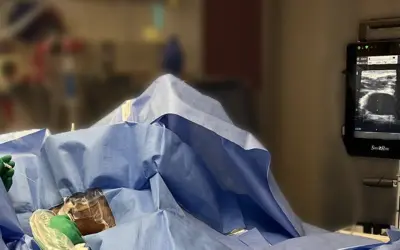
This patient had a left-sided AICD, or automated implantable cardioverter-defibrillator, which can make it hard to determine if the patient was in a sinus rhythm during the procedure. The advanced clinician knew that the facility policy allowed for ECG confirmation and required confirmation of placement using the tip locating device (the Sherlock). Because of this, the clinician would not be able to determine if he could clear the line for use with ECG until closer to the end of the procedure. The care team agreed with the plan to place a PICC line, and that if the vascular access clinician could see a regular P wave on the ultrasound machine’s ECG, then he would move forward with placing the PICC line.
The vascular access clinician explained this new plan with the patient and her family, and how a PICC line versus a Midline would reduce the risk of more pain and discomfort from phlebitis. The patient was nervous, but the clinician had explained the rationale in a way she could understand and explained that the procedure should feel very similar, if not the same, as the Midline that had been previously placed. She and her family felt comfortable after having a full discussion and agreed to the procedure.
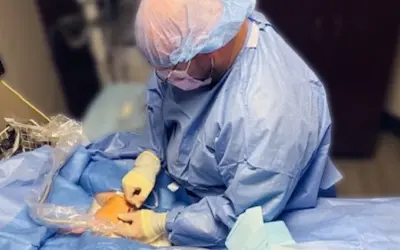
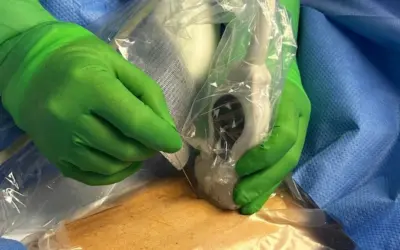
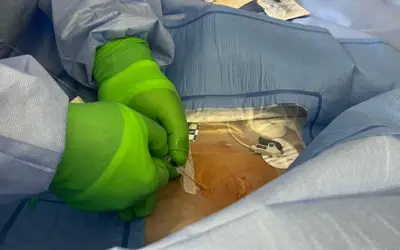
The clinician proceeded to assess the patient’s LUE vasculature and found a vessel with adequate CVR. He set up his Sherlock location device and observed a good rhythm with a regular P wave. The PICC line was placed without any issues, and the clinician confirmed placement with ECG clearance.
The patient, her family, and the care team were grateful to have comfortable and reliable vascular access in place that was free of complications and helped her pass away peacefully a few weeks later.
Meticulous Vascular Access Assessment for Hospice Patient
– Key Points
Vascular Access Specialists
Unlike others who provide mobile services – especially those who pay nurses on a pay-per-procedure model that creates an incentive for speed and quantity over quality – our hospital-credentialed Vascular Access Specialists are trained to take all the time needed before beginning every procedure or leaving the bedside or facility.
Vascular Wellness nurses perform a comprehensive medical history review and complete a thorough physical and visual patient assessment to help ensure the most clinically appropriate line is ordered and placed. They also spend as much time as needed to talk with the patient and family to answer all questions and address any concerns before they begin. Our comprehensive training, derived from the hundreds of thousands of lines placed since inception, and focus on the patient and client ensure the best and most thorough patient-centric care.
We’re proud to regularly help Hospice Centers and their patients receive comprehensive, empathetic, and compassionate care at the bedside, and to provide comfort for the patient and understanding for their family and friends. Comfort is an essential factor we consider when recommending the clinically appropriate vascular access device. Even though predictions of life expectancy may be short, we still perform a comprehensive medical review to make sure the patient and medical team understand the vascular access device options.
Our partnership with Hospice facilities as well as At Home patients enables us to bring high-quality care to patients wherever they are most comfortable, and to extend and add to that comfort as much as possible.
If you require Vascular Access or want to learn more, speak to the team at Vascular Wellness today.
For the latest articles and insights, follow us on LinkedIn, Facebook, Twitter, YouTube, and Instagram.
Vascular Wellness provides:
(1) Comprehensive vascular access services to Mississippi, North Carolina, Ohio, Oklahoma, Pennsylvania, South Carolina, and Virginia; and
(2) Customized vascular access services to Arkansas, Delaware, Georgia, Tennessee, and West Virginia; and
(3) Support vascular access services to Kentucky.
Read more NCIA Patient Cases
Need an Expert who can Place Central Lines?
We bring skilled, high-quality, timely care to patients in Hospitals, LTACHs, SNFs, Hospital at Home programs, and Outpatient facilities.