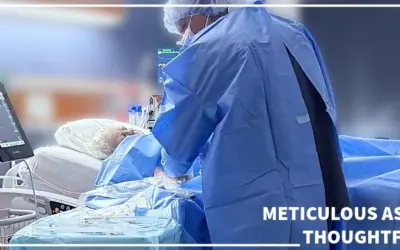
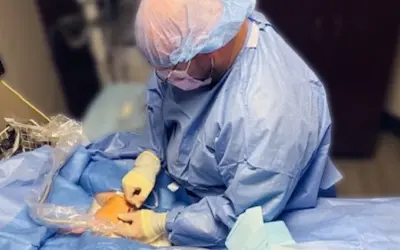
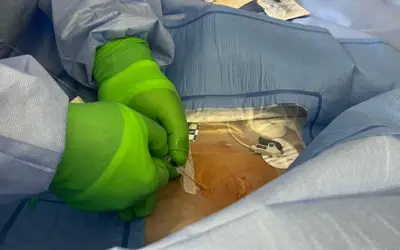
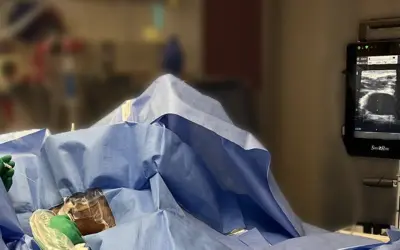
Dialysis Catheter, Mid-Thigh Femoral in Emergency Department describes a patient who came to the Emergency Department from a nursing home with a number of medical issues, including renal failure, and needed vascular access for hemodialysis.
Dialysis Catheter, Mid-Thigh Femoral in Emergency Department
– Clinical Case
An elderly patient with a history of dementia, UTIs (urinary tract infections), and several recent falls was transported to the Emergency Department from a local nursing home. She was diagnosed as having hypotension and needed vasopressors. In addition, she was in renal failure and needed urgent hemodialysis.
Dialysis Catheter, Mid-Thigh Femoral in Emergency Department
– Diagnosis and Treatment
The Emergency Department contacted Vascular Wellness and ordered a Large Bore Vascath, or temporary dialysis catheter, so the patient could begin dialysis treatment.
Upon arrival, the vascular access clinician saw that a physician from the facility was in the patient’s room attempting to place a central line. She waited outside the room until he finished, and in case her assistance was needed. A few minutes later, she began hearing noises from inside the room, so she knocked and went inside to check in with the physician and to see the patient.
The patient was uncomfortable, so the Vascular Wellness vascular access nurse assisted the physician by attempting to comfort her. After several unsuccessful attempts by the physician to place a central line, the vascular access nurse suggested that they pause, and she could place the ordered Vascath.
The physician agreed, and the nurse clinician stepped in and placed the temporary dialysis catheter on the first attempt. The facility had added a Small Bore Mid-Thigh Femoral central line to the existing Vascath order after the physician was unsuccessful in gaining central line access, and the Vascular Wellness nurse placed that line well.
With both the Large Bore Vascath and Small Bore Mid-Thigh Femoral lines in place and cleared for use, the patient was able to begin treatment without further delay.
Dialysis Catheter, Mid-Thigh Femoral in Emergency Department
– Key Points
Having a specialized vascular access partner whose advanced nurse clinicians are credentialed and skilled in the placement of advanced and innovative Small Bore and Large Bore advanced central lines, including Vascath and Tunneled Permcath dialysis catheters, greatly improves our clients’ ability to successfully treat patients quickly, with the clinically appropriate line, and helps improve patient outcomes and satisfaction.
Teaming with vascular access experts also means care teams and facilities can ensure greater patient comfort by eliminating painful, unsuccessful attempts at access that can delay treatment, cause medical complications, and increase treatment expense due to wasted costly supplies and time spent trying to gain access.
Partnering with vascular access specialists and experts who are deeply skilled, particularly in advanced procedures, and available for emergent and delicate cases such as this one at the bedside 7 days a week, including after-hours, weekends, and holidays, makes a tremendous difference in a facility’s ability to care for their patients.
Our dedicated professional team of vascular access experts are trained, precepted, and certified in the placement of standard and advanced central lines. Our clinicians are Vascular Access Board Certified (VA-BC), insured, and skill-verified, which means we deliver consistent, reliable, and quality services to the patient. And with no upfront cost or commitment, partnering with Vascular Wellness to have vascular access specialists available on-demand and on-site is generally an “easy” decision for most healthcare facilities, especially given that we promote teamwork internally and externally by either becoming an extension of a client’s in-house team or operating as their outsourced provider.
If you require Vascular Access or want to learn more, speak to the team at Vascular Wellness today.
For the latest articles and insights, follow us on LinkedIn, Facebook, Twitter, YouTube, and Instagram.
Vascular Wellness provides:
(1) Comprehensive vascular access services to Mississippi, North Carolina, Ohio, Oklahoma, Pennsylvania, South Carolina, and Virginia; and
(2) Customized vascular access services to Arkansas, Delaware, Georgia, Tennessee, and West Virginia; and
(3) Support vascular access services to Kentucky.
Read more NCIA Patient Cases
Need an Expert who can Place Central Lines?
We bring skilled, high-quality, timely care to patients in Hospitals, LTACHs, SNFs, Hospital at Home programs, and Outpatient facilities.