
In the Room Where it Happened: Whitney Page and Nurse-Placed Central Lines in South Carolina
Nurse-Placed Central Lines in South Carolina highlights the South Carolina Board of Nursing’s advisory opinion that adds central line placement by registered nurses (RNs) to their scope of practice in the state is a huge advancement and win for patients, and the result of years of work and dedication on the part of Vascular Access Board Certified (VA-BC) nurse, Whitney Page, who successfully led the effort to provide a collection of data showing its effectiveness and safety.
Drawing from Vascular Wellness’ commitment to a central line program dating back to 2011, Whitney drove the initiative to petition the board to advance healthcare for the betterment of patients in her home state. Key supporters included Stephen Harris, who developed the central line program and provided his experience and expertise working with central lines and Boards of Nursing; Nancy Warden, COO; and Whitney’s colleagues, both at Vascular Wellness (where she works) and in numerous healthcare facilities across South Carolina.
“I’m thrilled to honor Whitney Page and this momentous milestone in South Carolina. Whitney worked tirelessly with colleagues and the South Carolina Board of Nursing to enhance the scope of practice for nurses, and I’m so proud for her to be the first registered nurse in South Carolina to place a central line at the bedside!”
~ Nancy Warden, Chief Operating Officer, Vascular Wellness
A Look at Who Led the Effort to Bring Nurse-Placed Central Lines to South Carolina
As a registered nurse with 12 years of experience, including nearly six years of specialized vascular access training and experience, Whitney Page is the quiet powerhouse behind the success in bringing the placement of Small Bore Internal Jugular central lines into the scope of practice for RNs in South Carolina.
Before joining Vascular Wellness, Whitney spent several years in urgent care, cardiac and post-cardiac care, general surgery step-down units, and medical patient care. She was also a unit educator and clinical instructor for new nurses and student nurses, and continues to enjoy teaching, precepting, and practicing nursing in the community. Her experience with critical patients who often need urgent and/or additional vascular access is what initially piqued her interest in becoming a vascular access specialist and brought her to Vascular Wellness.
Whitney is a quick learner with a focus on continuous growth, and her “why” was always clear: her patients. Her initiative, skills, incredible bedside manner, and collaborative approach were a few of the many reasons why Whitney became – and has enjoyed continued success as – the Vascular Wellness Territory Manager for South Carolina.
Vascular Wellness services clients across multiple states, so our team of nurse clinicians is trained on more than just PICCs, Midlines, and ultrasound-guided Peripheral IVs (PIVS) as they advance in their careers. Because we work in compact and decision tree states, it is not uncommon for our more seasoned and skilled clinicians to cross nearby state lines to assist each other and our clients, placing lines for vascular access. So even though nurses were not permitted to place central lines in South Carolina, Whitney mastered placing advanced lines, including Internal Jugulars, Mid-Thigh Femorals, and Large Bore Dialysis Catheters in addition to PICCs, Midlines, and ultrasound-guided Peripheral IVs (PIVs), and she supports her teammates in neighboring states.
Whitney has built a strong and cohesive team of vascular access nurses in South Carolina. Not only is she focused on continuing to grow her experience and skills, but she also enjoys mentoring her team and helping them grow their vascular access skills.

Whitney Page with Vascular Wellness
A Vision to Bring Nurse-Placed Central Lines at the Bedside to South Carolina
Year after year, Whitney saw the impact that she and her nurse colleagues made in providing patients in other states with critically needed advanced vascular access (central lines) at the bedside, while patients in South Carolina were left behind. Because patients in South Carolina were dependent on physicians and surgeons for all central line placement, their treatments were often delayed as compared to nurse-placed lines at the bedside while arrangements were made for transportation to other facilities via ambulance, or even within their current facility. Scheduling of procedures was dependent on the availability of Operating room (OR) suites and staff, or Interventional Radiology (IR) departments to fit these cases into their already filled schedules. Oftentimes, the delays stretched across multiple days, and she had no choice but to watch patients suffer while they waited.
Whitney knew that a few years prior, the South Carolina Board of Nursing (BON) had been petitioned to add placement of central lines to the scope of practice for nurses, but the petition was denied. After seeing one too many cases where allowing a central line could have made a tremendous difference in the recovery of patients in her home state, Whitney decided another effort was warranted, and she got to work.
Understanding The Role of the Board of Nursing in Each State
Boards of Nursing are state agencies whose primary role is to ensure the safety of patients in their respective states through licensing guidelines, approval of education programs, evaluation of the scope of practice and possible enhancements, and investigating complaints. Because they are state-specific, each BON can determine what is included within the scope of practice – or what is allowed – for registered nurses in their state.
Adding to a nurse’s scope of practice is a formal and lengthy process that includes submitting an application outlining a developed position on practice or procedure; relevant circumstances and data; education, training, and skills required; addressing if the practice in question is performed in other states and where; an analysis of other states’ treatments; providing documentation; and more. Committee hearings and discussions take place, petitioners are questioned, experts and opinions are called upon, and then the board ultimately issues an advisory or decision. Advisories, also called advisory opinions or statements, are how a state’s BON communicates what is permitted within the nurse’s scope of practice in their state.
How Nurse-Placed Central Lines in South Carolina Came to be Part of their Scope of Practice

Nurse-Placed Central Lines
Whitney Page
Petitioning to expand the scope of practice takes diligence and perseverance on many levels, and Whitney was up to the challenge. Over the next several months, she had conversations with colleagues from myriad healthcare settings and facilities across the state and explained why she believed advancing the scope of practice was critical to the patients of South Carolina.
Whitney sacrificed numerous evenings, weekends, and days off – with the full backing of her husband and daughters – to gain support and collect signatures from over 50 providers from client facilities to advocate for RNs to place CVCs in South Carolina. The petition gained momentum quickly. She gathered research, prepared statements to be brought before the board, met with South Carolina BON members, attended conferences and meetings, participated in numerous hearings and discussions, and answered questions as to why South Carolina should make the requested enhancement.
When Whitney was asked about the training RNs needed in order to safely place advanced central lines at the bedside, she referenced the hundreds of thousands of lines placed by her Vascular Wellness team over 14 years across many states, including thousands upon thousands of advanced central lines. Whitney also shared how our team built a rigorous, specialty-level training program, including live sticks that trains and awards competencies to RNs, APPs, and Physicians across the country who learn to safely perform advanced lines at the bedside. She explained that this same training was what she had both received and given.
The case was persuasive and sound, and the South Carolina BON made its ruling.
What was Added to Scope of Practice for Nurses in South Carolina
In September of 2025, the South Carolina Board of Nursing issued Advisory Opinion #79 stating the following:
The State Board of Nursing for South Carolina acknowledges that it is within the expanded role and scope of the registered nurse (RN) to insert a small bore internal jugular intravenous catheter utilizing ultrasound guidance in the non-pediatric patient.
The advisory goes on to outline considerations and guidelines around nurse placement of Small Bore Internal Jugulars. Even with these conditions, this is a very important and momentous first step in the advancement of patient care in South Carolina.
Despite the win for patients, it was also a disappointment that the advisory stopped at small-bore internal jugular CVCs. More on that in a moment, but let’s take a look at the first nurse-placed central line patient case in South Carolina!
“I’m honored to have been part of this milestone for South Carolina. Placing the first nurse-placed IJ in the state wasn’t just a single procedure; it was the result of years of training, advocacy, and support from my incredible team at Vascular Wellness. I’m grateful for the opportunity to help move our profession forward and to show what skilled, specialty-trained RN clinicians can safely do at the bedside. Proud of our team and excited for what comes next.”
~ Whitney Page, RN, BSN, VA-BC, Vascular Wellness
In the Room Where it Happened: Whitney Page was the First Nurse to Place a Central Line in South Carolina
Not long after the advisory was issued, it was no surprise that a patient case came about where a Small Bore Internal Jugular line was ultimately exactly what the patient needed. In this case, the provider ordered a Midline, which was the correct type of vascular access for the treatment protocol. Whitney arrived at the patient’s bedside and conducted a thorough physical assessment as well as a review of the medical history and planned treatment to ensure there were no contraindications.
She recognized there was a chance that the patient’s vasculature would not support access in her upper extremities based on her assessment, but she felt it was best to try the most appropriate and least invasive line for the therapy prescribed. Given that the patient’s left side met the requirements, she attempted to place a Midline as ordered.

First Nurse-placed IJ in South Carolina
by Whitney Page
However, the guidewire could not be advanced, likely due to extensive venipuncture history and many prior Midlines, PICCs, and central lines (which the patient noted, and later said she was not surprised that the Midline would not be successful).
With the significant bruising on both arms from the previous failed attempts prior to her arrival, the patient’s DIVA condition, and the inability to advance the guidewire due to what might be stenosis of the veins from the extensive history of vascular access devices, Whitney determined that a central line was the next best option so the patient could continue therapy without delay.
Prior to the scope of practice enhancement, a procedure in the OR Suite or Interventional Radiology would need to be prearranged, and the patient would need to be transported via ambulance to and from the main hospital.
Whitney consulted with the patient’s care team and discussed the situation. She explained why she recommended a right-sided Small Bore Internal Jugular central line, and that she could place that line right away and eliminate any delays. The provider readily agreed with the recommendation and changed the order. The line was placed easily on the first attempt during that same visit, and she placed it anatomically lower and near the clavicle, making care and maintenance of the line much easier, as well as making it more comfortable for the patient.
Whitney spent time with the nurses to ensure they knew exactly how to care for the Internal Jugular line, and they were grateful for the time and expertise.
“As a colleague of Whitney’s, I am incredibly proud that she saw this multi-year process through and was thrilled to hear that the process was capped off by her actually placing the first internal jugular central line in South Carolina!”
~ Stephen Harris, Director of Research and Development, Vascular Wellness
Read the full story:
First South Carolina Nurse-Placed Internal Jugular CVC
South Carolina Should Continue the Advancement of Nurse Scope of Practice
Numerous states’ Boards of Nursing (BONs) across the US have added placement of central lines to the scope of practice for registered nurses years ago, and many allow specially trained nurses with the required expertise and competencies to place central lines, or CVCs, of all types.
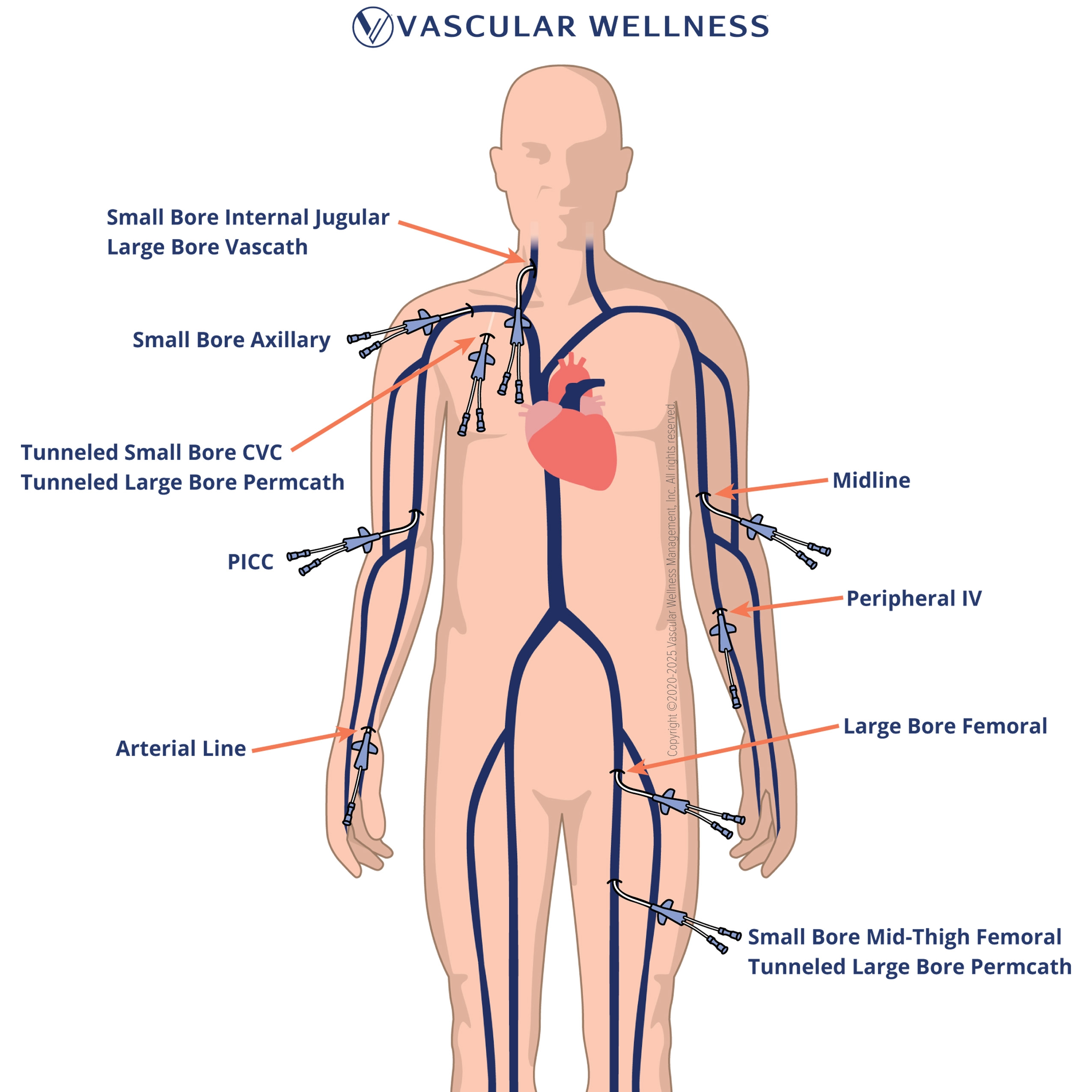
Under the direction of Stephen Harris, our Director of Research and Development, our vascular access nurses are highly trained, experienced, and expertly place a comprehensive list of vascular access devices, including Small Bore and Large Bore central lines, with a 98% success rate and 0% insertion-related infection rate via ultrasound guidance:
• Tunneled Large Bore Permcaths
• Large Bore Vascaths
• Large Bore Femorals
• Tunneled Small Bore CVCs
• Small Bore Internal Jugular lines
• Small Bore Mid-Thigh Femoral lines
• Small Bore Axillaries
• PICCs
• Midlines
• Arterial Lines
• Peripheral IVs
Whitney still believes that the scope of practice for nurses can expand in South Carolina, and she remains committed to continuing the efforts, as does the South Carolina Board of Nursing, as additional data is gathered and presented. This partnership between Whitney and the South Carolina BON is clearly a win and an opportunity for future innovation.
For now, Whitney is taking a moment to savor making history, not only by being the first RN to place a central line in South Carolina, but also by being in the room where it happened – leading the way to advance healthcare through empowering nurses and making a direct impact on patient care in her beloved home state.
Patients in South Carolina are the True Winners
The patients have been the true winners, with a dramatic improvement in the speed at which they can receive these vascular access devices that are critically needed, often urgently. And because nurse-placed central lines are done at the bedside without the need for sedation or transportation within the facility or via ambulance to a hospital, they are associated with a dramatically reduced risk of infection and cost.
Enabling nurses who are specially trained experts in the placement of central lines enables patients to receive the ordered vascular access when they need it, and allows patients and their providers to avoid unnecessary and potentially dangerous delays in treatment, eliminates unnecessary exposure to illness and infections, and decreases costs for all by eliminating the need for an Operating Room suite and staff, or even Interventional Radiology. Facilities, providers, staff, and patients applaud this step that South Carolina has taken and look forward to additional vascular access-related advisories in the future.
Vascular Access Patient Cases:
Read our Clinical Cases from the Front Lines of Vascular Access Care

We place the right line at the right time, the first time.
Call us at 877-284-4435 or email us to learn more.
No upfront cost or commitment to get started.
If you require Vascular Access or want to learn more, speak to the team at Vascular Wellness today.
For the latest articles and insights, follow us on LinkedIn, Facebook, Twitter, YouTube, and Instagram.
Vascular Wellness provides:
(1) Comprehensive vascular access services to North Carolina, Oklahoma, South Carolina, and Virginia; and
(2) Customized vascular access services to Arkansas, Delaware, Georgia, Mississippi, Pennsylvania, Tennessee, and West Virginia; and
(3) Support vascular access services to Ohio and Kentucky.
