Severely Contracted Patient Needs Vascular Access describes a case in an LTACH where a patient needed new vascular access because the arm with an existing Midline was swollen, red, and warm to the touch, and the facility suspected a DVT (deep vein thrombosis). The physician ordered the Midline to be removed and replaced, but the Vascular Wellness clinician was concerned that it would be contraindicated.
Severely Contracted Patient Needs Vascular Access
– Clinical Case
An LTACH severely contracted patient with a history of diabetes was receiving a continuous 5% dextrose (D5) drip via an existing Midline placed by someone other than Vascular Wellness. With the patient’s blood sugar levels becoming increasingly unstable, the care team needed to administer GlucaGen, ertapenem (antibiotic), fluids, and potassium, but the insertion site of the Midline was red and inflamed. The physician stated that the swelling had just become apparent that morning and within the last few hours. Knowing that the patient needed a working Midline to receive the additional therapies, the physician ordered the Midline to be removed and another inserted in its place, and the facility contacted Vascular Wellness to perform the procedure.
The vascular access clinician arrived a short while later and began a detailed patient assessment, observing that the patient was bilaterally contracted, with a severe case of contraction on the left side of the body. The patient’s only IV access was the RUE (right upper extremity) Midline, and the clinician noted and confirmed that the arm was swollen, red, and warm to the touch, as was indicated by the staff nurse.
Severely Contracted Patient Needs Vascular Access
– Diagnosis and Treatment
A continuous 5% dextrose drip was being administered via the Midline which indicated the line was still functional, however, the Vascular Wellness clinician was concerned there might be a clot or other issue due to a number of factors, including the redness and swelling that was observed. Based on her training and expertise, she knew that removal of that Midline and insertion of a new Midline before confirming there was no presence of a clot would likely increase the patient’s risk for a DVT. Additionally, in the presence of DVT, the removal of one line and replacing that line in the opposite arm brings a significant increased risk of developing a clot in the new arm, as well.
The clinician noticed that the doctor had documented the same situation of redness, swelling, and pain six days prior and had ordered a doppler. The results of that study were negative for a DVT, but inconclusive for a superficial venous thrombosis or SVT, as the ultrasound technician performing the doppler could not visualize the brachial and cephalic veins in the right arm. The ultrasound technician had suspected this might be cellulitis or an infiltration of the midline.
Given the lack of improvement in the affected arm, the Vascular Wellness clinician contacted the patient’s care team and recommended another doppler be ordered to rule out a clot because if present, the recommended protocol would be to remove the existing Midline and replace with an advanced central line to decrease the risk of possibly developing another blood clot in the patient’s other arm. The bedside nurse was advised to discontinue use of the Midline in case it was infiltrated and to insert a PIV (peripheral IV) for the D5 drip to continue treatment until the course of action was determined.
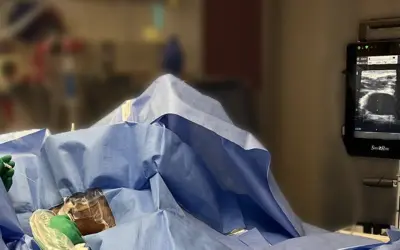
In the meantime, the Vascular Wellness clinician tended to another case within the facility and upon completing that case, was informed that the doppler yielded the same result, and an Internal Jugular (IJ) central line was being ordered for the initial patient. The Vascular Wellness clinician returned to the bedside and began preparations for the right-sided IJ via ultrasound guidance because while the patient was bilaterally contracted, the left side was more severe. Despite the clinician’s skill level and care, the catheter traveled up the patient’s neck rather than dropping down into the SVC (superior vena cava) as it should. The clinician tried to power flush the catheter into the correct position but was unsuccessful. A second attempt was made to remove the initial catheter and insert a new catheter through an exchange to position the catheter within the appropriate location within the SVC, but this attempt was also unsuccessful. The patient’s condition was deteriorating, and the facility staff was considering IO access (a procedure where a needle is inserted into a bone to gain IV access) as a short-term but immediate solution.
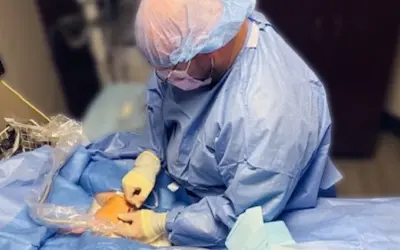
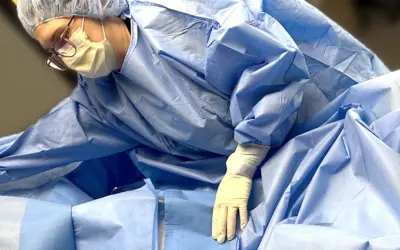
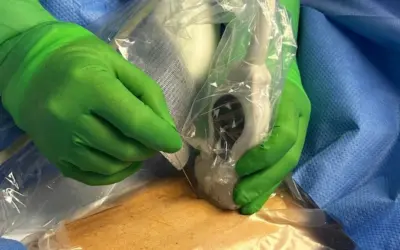
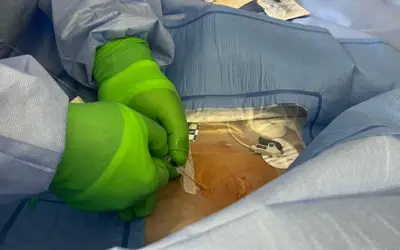
Because the Vascular Wellness clinician was extensively trained in several advanced central line procedures, she explained to the care team that with permission, she could place a more clinically appropriate Small-Bore Mid-Thigh Femoral central line, which is a less invasive and longer-term solution than IO access. Additionally, because every clinician comes to each patient’s bedside with all the catheter kits, supplies and equipment needed in case the patient’s condition or needs change, she was able to begin the procedure immediately. The APRN and doctor agreed to the procedure, and the Vascular Wellness clinician quickly obtained vascular access via the Mid-Thigh Femoral approach on the first attempt.
Proper placement of the line was confirmed, and staff began using the new line immediately. The care team was thrilled to have the vascular access that was needed, and that no transportation or additional staff or procedures were needed.
Vascular Access Specialists
– Key Points
Partnering with a provider who specializes in vascular access, and whose nurse clinicians are credentialed and skilled in the placement of innovative small-bore and large-bore advanced central lines (including Vascath and Tunneled Permcath dialysis catheters), greatly enhances our clients’ ability to successfully treat patients quickly, eliminates the need for transportation to another facility and the coordination and costs associated with it, and helps improve patient outcomes and satisfaction.
This case clearly demonstrates how partnering with vascular access specialists and experts who are deeply skilled, particularly in advanced procedures, and available for emergent and delicate cases such as this one at the bedside 7 days a week, including after-hours, weekends, and holidays, makes a tremendous difference in a facility’s ability to care for their patients. Unlike other mobile companies, our salary-based W2 employee clinicians are trained to spend as much time with the client and patient as necessary to ensure the most clinically appropriate solution – the primary goal of any healthcare procedure.
We proudly support a greater than 98% success rate and 0% infection rate across both standard and advanced lines and regularly place more standard and advanced vascular access devices in our service areas than virtually any other vascular access company. Our patient-centric and client-centric approach ensures the right line, as clinically indicated, is placed at the right time – the first time – at the bedside to enable our partner facilities to avoid delay cascades of treatment, improve patient outcomes, and reduce costs.
Nurse Clinicians in Action is a spotlight series highlighting some of the interesting cases that Vascular Wellness clinicians have encountered and participated in treatment. These cases involve challenging situations or intriguing clinical presentations and may involve more than one Vascular Wellness clinician, as our clinicians have the ability to consult each other while in the field, as well as an on-call Clinical Administrator via a HIPAA (Health Insurance Portability and Accountability) compliant communication app. In addition, our extensive training program and diverse client base, including Level 1 Trauma Centers, Short Term Acute Care Hospitals, Long Term Acute Care Hospitals, and Skilled Nursing Facilities, provide our clinicians with a wide array of clinical experience and why we believe our clinicians, as a group, are the most experienced and best trained and supported vascular access clinicians.
If you require Vascular Access or want to learn more, speak to the team at Vascular Wellness today.
For the latest articles and insights, follow us on LinkedIn, Facebook, Twitter, YouTube, and Instagram.
Vascular Wellness provides:
(1) Comprehensive vascular access services to Mississippi, North Carolina, Ohio, Oklahoma, Pennsylvania, South Carolina, and Virginia; and
(2) Customized vascular access services to Arkansas, Delaware, Georgia, Tennessee, and West Virginia; and
(3) Support vascular access services to Kentucky.
Read more NCIA Patient Cases
Nurse Clinicians in Action stories highlight some of the interesting cases in which Vascular Wellness clinicians have encountered and participated as valuable team members.
Need an Expert who can Place Central Lines?
We bring skilled, high-quality, timely care to patients in Hospitals, LTACHs, SNFs, Hospital at Home programs, and Outpatient facilities.